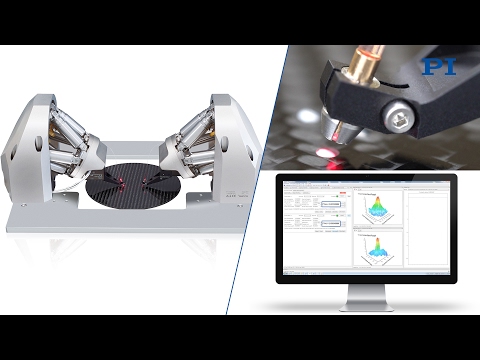
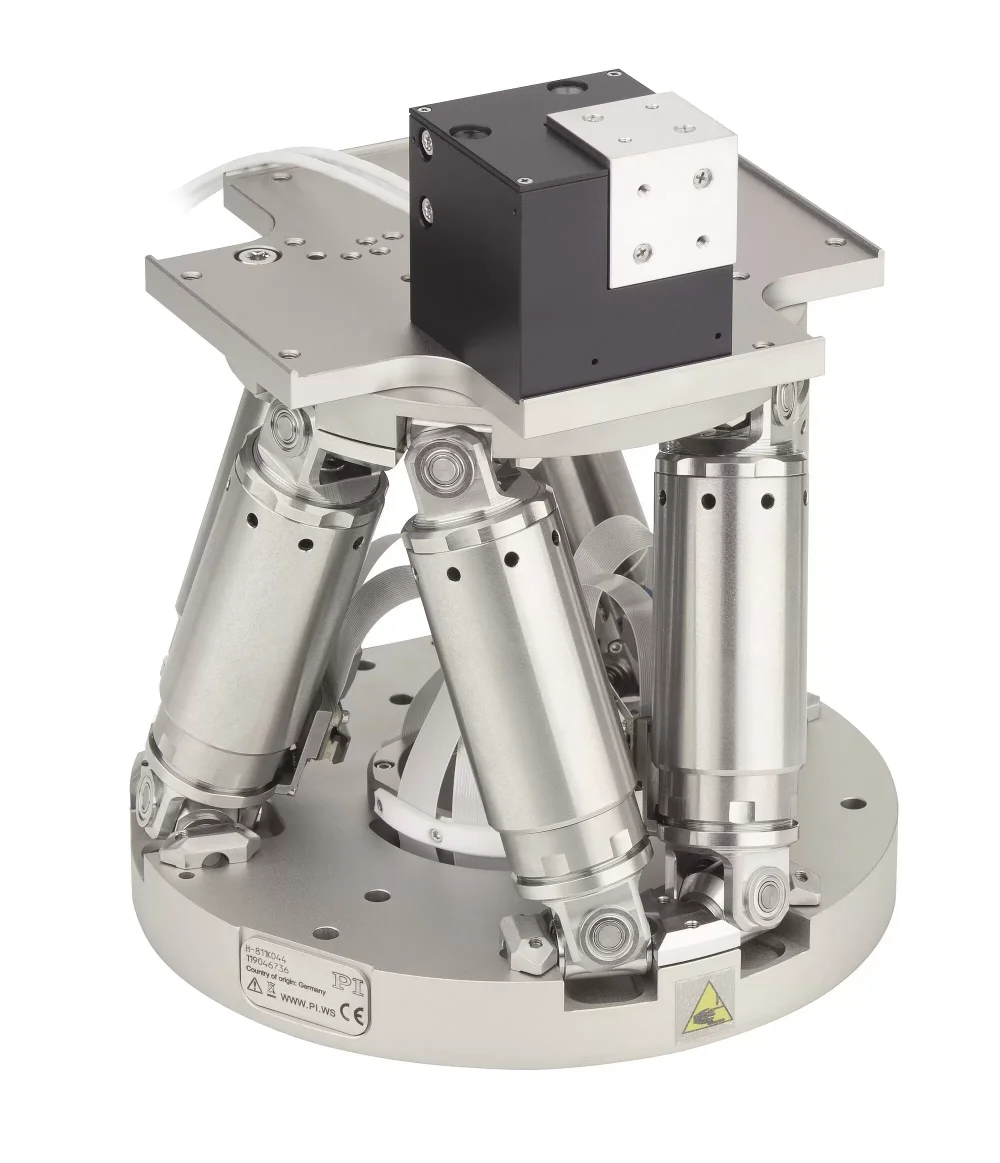
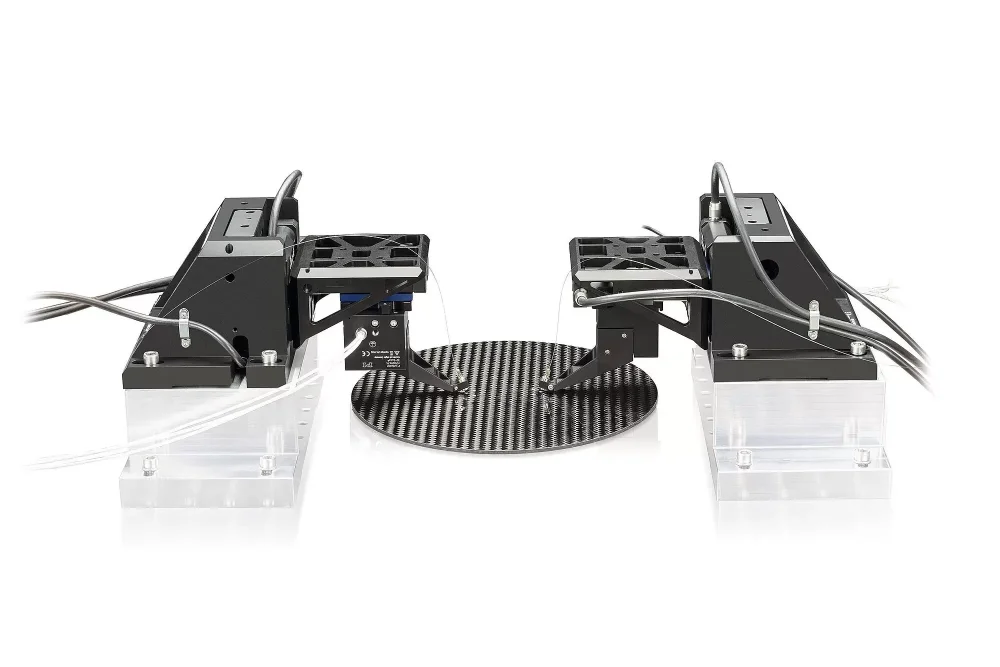
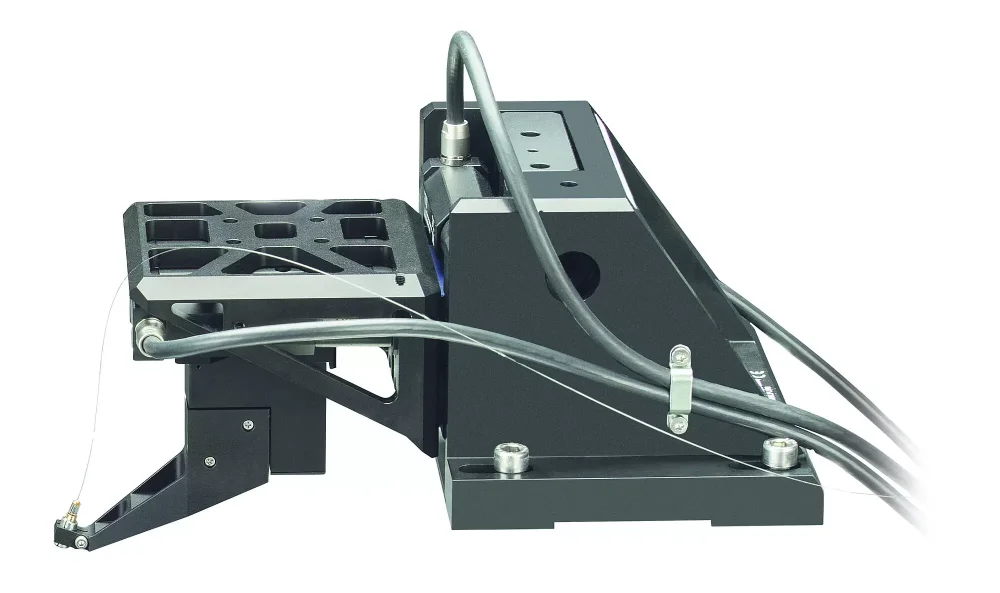
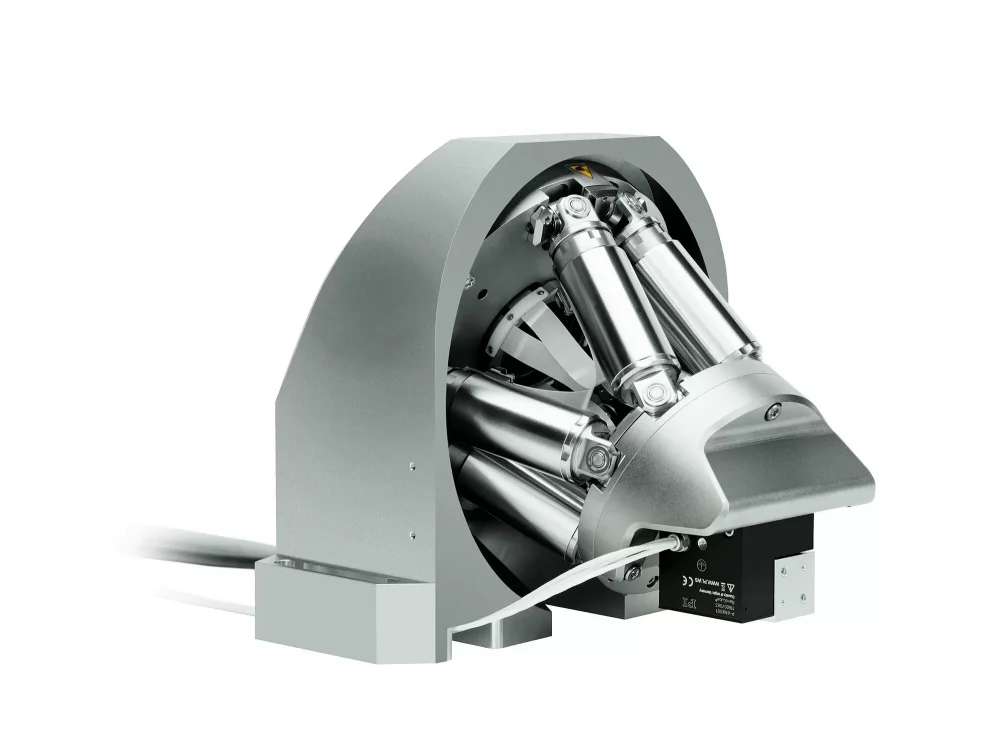
The basis of the fiber alignment system is a very stiff setup with an H-811 hexapod and an P-616 NanoCube® nanopositioner. The parallel-kinematic design for motion in degrees of freedom ensures high system stiffness. The motorized drives make longer travel ranges possible and at the same time, the NanoCube® nanopositioner ensures fast scanning motion and dynamic compensation of drift effects. Flexure guides and all-ceramic insulated PICMA® actuators guarantee a long lifetime. Because all drives are equipped with position sensors, it is possible for example, to reliably prevent collisions with expensive silicon wafers.
The software package supplied in the scope of delivery allows integration of the system into virtually any environment. All common operating systems such as Windows, Linux, and MacOS as well as a large number of common programming languages including MATLAB and NI LabVIEW are supported. Thanks to sophisticated program examples and the use of software tools such as PIMikroMove, the time between starting integrating and productive operation is shortened considerably.
Alignment of optical components, automatic wafer tests, assembling technology in silicon photonics
The sophisticated scan routines are integrated directly into the controller. The performance is improved considerably and integration simplified. The system can manage all tasks in the field of fiber alignment. For example, double-sided systems allow simultaneous alignment of the transmitter and receiver.
The controller receives the optical intensity signal directly via a high-resolution analog input. Complex setups with cameras are not necessary. Various distribution functions are available for determining the maximum intensity.
Motion and positioning | F-712.HA2 | Unit |
|---|---|---|
Number of active axes | 18 | |
Rough positioning | ||
Active axes | X, Y, Z, θX, θY, θZ | |
Travel range in X, Y, Z | ±6.5, ±16, ±8.5* | mm |
Travel range in θX, θY, θZ | ±14.5, ±10, ±10* | ° |
Minimum incremental motion | 0.1 | µm |
Max. velocity | 10 | mm/s |
Sensor type | Rotary encoder | |
Guide | – | |
Drive type | Brushless DC motor | |
Fine positioning | ||
Active axes | X, Y, Z | |
Travel range in X, Y, Z, closed loop | 100 | µm |
Min. incremental motion, open-loop | 0.3 | nm |
Min. incremental motion, closed-loop | 2.5 | nm |
Linearity error, for the entire travel range** | 2 | % |
Repeatability (bidirectional) 10% travel range | 2 | nm |
Sensor type | Incremental | |
Drive type | PICMA® | |
Alignment | ||
Scanning time of spiraled area scan 500 µm Ø** | <5 | s |
Scanning time of spiraled area scan 100 µm Ø** | <1 | s |
Scanning time of spiraled area scan 10 µm Ø** | <0.5 | s |
Scanning time, gradient scan, randomized with ±5 µm (repeatability < 0.01 dB)*** | <0.3 | s |
Miscellaneous | F-712.HA2 | Unit |
|---|---|---|
Operating temperature range, mechanics | 0 to 50 | °C |
Operating temperature range, controller | 5 to 40 | °C |
Cable length | 2 | m |
Requirements for the optical power meter | Unit | |
|---|---|---|
Output signal | Analog output, ideally converted from linear to logarithmic | |
Output voltage range, max. | -5 to 5 | V |
Bandwidth, min. | 1 | kHz |
Noise level, max. | -60 | dBm |
Technical data specified at 20±3 °C.
* The travel ranges of the individual coordinates (X, Y, Z, θX, θY, θZ) are interdependent. The data for each axis in this table shows its maximum travel range, where all other axes and the pivot point are at the reference position.
See the dimensional drawings for the default coordinate system and pivot point coordinates of the hexapod. Changing the pivot point will reduce the travel range in θX, θY, θZ. Changing the orientation of the coordinate system (e.g., when the optical axis is to be the Z axis), will change the travel range in X, Y, and Z.
** without polynomial linearization
*** typical time span for scanning the entire area and moving to the highest intensity
*** reaching the global maximum after first light has been found